

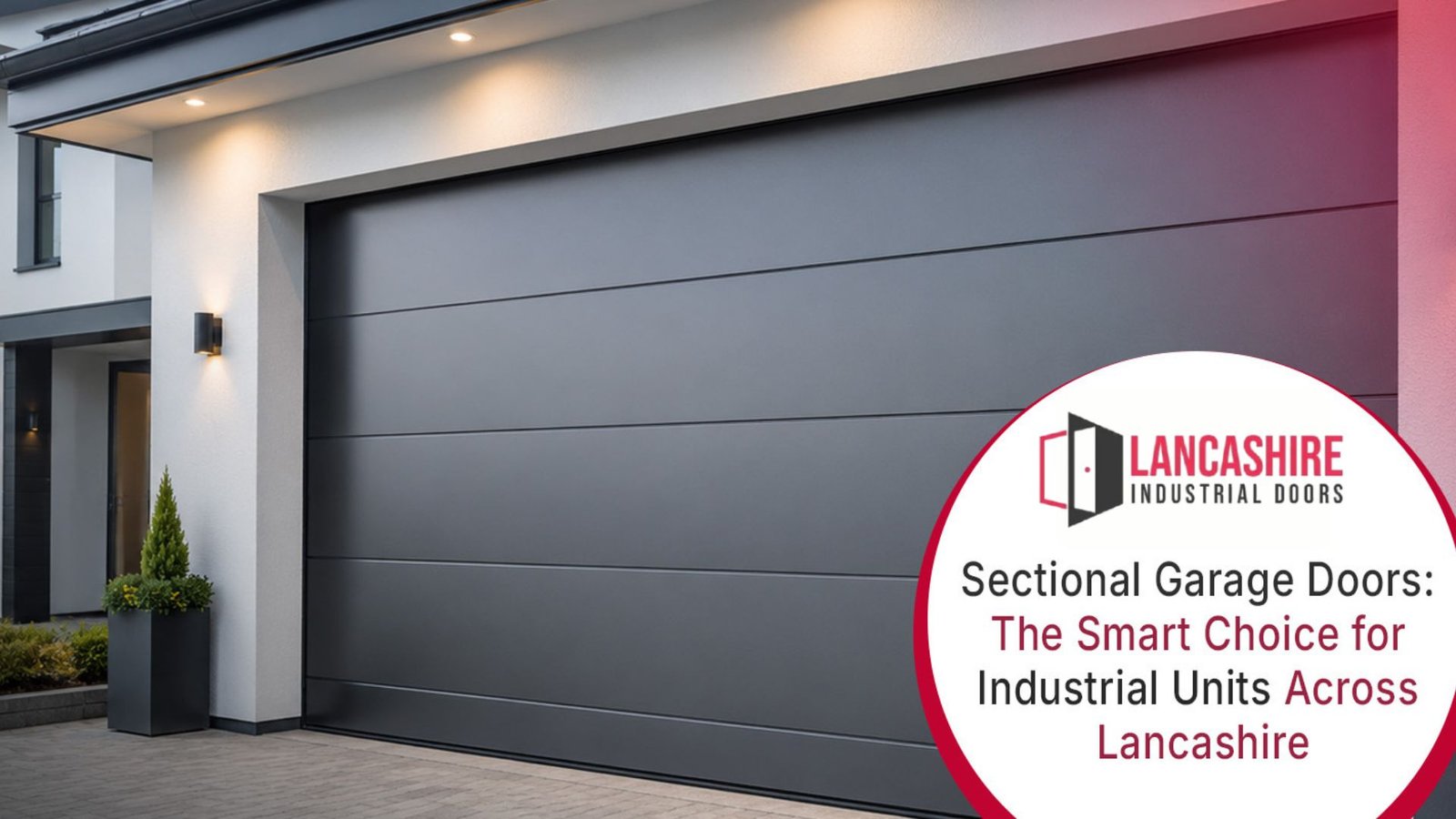
Lancashire’s industrial heartland, from the manufacturing estates of Preston and Burnley to the logistics parks around Blackburn and the trading estates scattered across Rossendale and Chorley runs on efficiency. Every hour of operational downtime has a cost, and in premises where vehicles, equipment, and staff are moving in and out throughout the day, the door at the entrance to your unit is doing more work than most people give it credit for. Sectional garage doors have become the preferred choice for industrial operators across the region, and the reasons come down to something very straightforward: they work better, last longer, and take up less space than the alternatives.
Why They Suit Industrial Premises Better Than Traditional Options?
The fundamental advantage of sectional doors over traditional up-and-over or roller alternatives is in how they open. Rather than swinging outward, which requires clear space in front of the opening and creates a hazard for vehicles and pedestrians passing close to the entrance, sectional doors rise vertically and travel back along the ceiling line inside the building. The result is a full, unobstructed opening at ground level with no projection outside the building line.
For those Lancashire factory units where loading bay is small, HGVs require maximum proximity to the loading bay entry, or even where there is just not enough room in the forecourt area for an outward swinging door, this becomes critically important. The other benefit of sectional doors is that, unlike many others, they seal well when closed, the horizontal panels sealing against the perimeter seals when compressed, thereby preventing drafts, rain, and cold Lancashire winds.
The Operational Case for Going Electric
For any industrial premises with regular vehicle access, manual operation of a large door is not just inconvenient, it is a genuine operational inefficiency that accumulates cost and frustration across hundreds of cycles a week. Electric sectional garage doors resolve this entirely.
The specification of a properly-designed electric operator will ensure that the door opens and closes with the touch of a button, is compatible with access control systems, and can also be programmed to close after a certain amount of time, thus preventing the frequent occurrence of a door remaining open by mistake in a hectic shift period. Electric sectional doors will also feature safety edge protection on the bottom panel, ensuring that the door stops and reverses course should it encounter anything while closing.
This is crucial for any working environment as it provides protection against injury. Remote door opening and closing is another benefit offered by electric sectional garage doors through the use of fobs, keypads, and even smartphone apps when the place of work is operated in several shifts or after normal working hours.
When Security Is the Whole Point
Not every industrial application calls for the same specification. Premises storing high-value stock, sensitive equipment, or materials that present a theft or liability risk need a door that functions as a genuine security barrier rather than simply an environmental one. Industrial security doors in sectional format are engineered specifically for this requirement.
Steel-faced panels, reinforced locking systems with multi-point locking bars, and frames designed to resist forced entry attacks significantly raise the protection level beyond what a standard sectional door provides. Industrial security doors are also frequently specified on premises where insurance conditions require a minimum physical security standard, and in those cases, the door specification is not a choice at all but a contractual necessity.
Lancashire businesses that handle overnight stock, operate unmanned premises, or are located on estates with a history of break-in attempts consistently find that upgrading to a properly specified security door reduces both incidents and insurance premiums in ways that justify the additional outlay within a relatively short period.
Specification, Sizing, and Getting the Installation Right
One area where industrial door projects frequently run into avoidable problems is sizing. Sectional garage doors are manufactured to fit the structural opening, and if the opening dimensions are not measured accurately, accounting for the header space needed above the opening for the door panels to stack, and the side room required for the guide tracks, the installation will either require structural modification or compromise the usable opening height.
Across Lancashire’s industrial estates and commercial premises, sectional garage doors have earned their position as the practical, reliable, and space-efficient default for operators who need their entrance to work as hard as the business behind it. Whether the requirement is for standard sectional doors to replace ageing up-and-overs, electric sectional garage doors to streamline daily operations, or industrial security doors to raise the protection level on a high-risk premises, the right door, correctly specified and professionally installed, is one of the most effective operational investments a Lancashire business can make.
Frequently Asked Questions (FAQs)
How much headroom is needed to install sectional garage doors?
Most standard sectional door installations require a minimum of 200–300mm of headroom above the structural opening; low-headroom track configurations are available for premises with restricted ceiling height.
Are electric sectional garage doors suitable for high-cycle industrial use?
Yes, commercial-grade electric operators are rated for significantly higher daily cycle counts than domestic versions; specifying an industrial-rated operator from the outset avoids premature wear in busy premises.
What security rating should I look for in industrial security doors?
Look for doors tested to LPS 1175 or equivalent standards; your insurer may specify a minimum-security rating, so check your policy before finalising the specification.
Can sectional doors be retrofitted into an existing opening?
In most cases yes, provided there is adequate headroom and side room for the track system; a site survey before ordering will confirm whether any structural modifications are needed.
How long do sectional garage doors typically last in an industrial setting?
A well-maintained sectional door in industrial use should last 15 to 20 years; springs are the most commonly replaced component and are typically rated for 25,000 to 50,000 cycles depending on specification.
Comments are closed